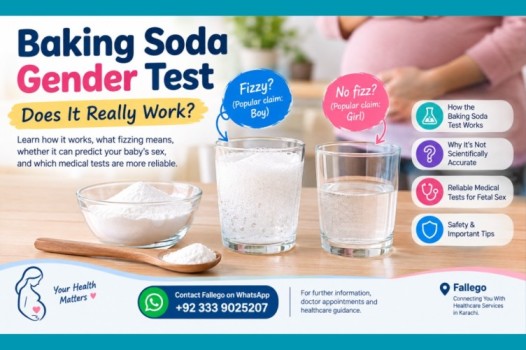
The baking soda gender test is a popular home method that many people use during pregnancy to try to predict whether they are having a baby boy or girl. The method is simple, inexpensive, and widely discussed on social media and pregnancy forums.
According to the popular claim, mixing a pregnant woman’s urine with baking soda can supposedly reveal the baby’s sex based on whether the mixture fizzes or bubbles.
But does the baking soda gender test actually work?
The short answer is no. There is no reliable scientific evidence that the reaction between baking soda and urine can determine the sex of an unborn baby. The fizzing reaction is more closely related to the acidity or pH of urine, rather than the baby’s biological sex.
In this article, Fallego explains how the baking soda gender test is performed, why people believe it works, what causes the fizzing reaction, and which medical methods can actually provide reliable information about fetal sex.
Karachi is home to hundreds of labs, but not all offer the same quality, accuracy, and convenience. In this detailed 2026 guide, we will cover the best labs in Karachi, price ranges, services, and how to book online through Fallego.
What Is the Baking Soda Gender Test?
The baking soda gender test is an old-fashioned pregnancy gender prediction method that has become popular online.
The basic idea is that a pregnant woman collects a urine sample and adds baking soda to it. Some people claim:
- Fizzy or bubbly reaction = baby boy
- Little or no reaction = baby girl
However, these claims are not medically proven.
The reaction between urine and baking soda can happen because baking soda is alkaline, while urine can contain varying levels of acids. When an acid reacts with sodium bicarbonate, carbon dioxide gas can be released, which creates bubbles or fizzing.
Therefore, the reaction does not provide a dependable indication of whether the baby is male or female.
How Is the Baking Soda Gender Test Done?
People who try this home test generally follow a simple process.
Commonly described method:
- Collect a small amount of fresh urine in a clean container.
- Add a few spoonfuls of baking soda to another clean container.
- Pour the urine over the baking soda.
- Observe whether the mixture fizzes or bubbles.
- According to the popular internet theory, strong fizzing is said to indicate a boy, while little or no fizzing is said to indicate a girl.
It is important to understand that this is a traditional or internet-based prediction method, not a medically validated gender test.
The result can change depending on urine concentration, diet, hydration, medications, and other factors.
Why Does Baking Soda Fizz With Urine?
The science behind the fizzing reaction is much simpler than the gender prediction theory suggests.
Baking soda, also called sodium bicarbonate, is an alkaline substance. When it comes into contact with an acidic substance, a chemical reaction can produce carbon dioxide gas.
That gas appears as bubbles or fizz.
Urine naturally has a particular pH range, and its acidity can vary from person to person and from one time of day to another.
Several factors may influence urine pH, including:
- Diet
- Hydration
- Certain medications
- Metabolic factors
- Urinary conditions
- Timing of the urine sample
Because these factors can affect the reaction, the amount of fizzing cannot reliably tell you anything about the baby’s sex.
Does the Baking Soda Gender Test Really Work?
There is no established scientific evidence showing that the baking soda gender test can accurately determine fetal sex.
The reaction is based on the chemical properties of urine and baking soda rather than a biological signal from the fetus.
This means that two pregnant women carrying babies of the same sex could potentially have completely different reactions.
Likewise, two women carrying babies of different sexes could have similar reactions.
For this reason, the baking soda gender test should be considered a fun pregnancy myth rather than a diagnostic test.
Baking Soda Gender Test vs. Medical Testing
There is an important difference between a home pregnancy gender prediction method and medically validated testing.
A home test such as the baking soda method does not examine fetal chromosomes or directly visualize the fetus.
Medical testing can provide much more reliable information.
Depending on the stage of pregnancy and the clinical situation, healthcare professionals may use methods such as:
Ultrasound
An ultrasound examination uses sound waves to create images of the developing baby.
During an appropriate stage of pregnancy, the baby’s anatomy may allow a trained healthcare professional to identify the fetal sex.
However, the visibility can depend on factors such as fetal position, gestational age, image quality, and the skill of the person performing the scan.
Non-Invasive Prenatal Testing (NIPT)
NIPT is a blood test that analyzes small fragments of fetal DNA circulating in the mother’s blood.
Some NIPT tests can provide information about fetal sex along with screening information for certain chromosomal conditions.
NIPT is a medical screening test and should be discussed with a qualified healthcare professional to understand what the test can and cannot tell you.
Diagnostic Genetic Testing
Certain diagnostic procedures can analyze fetal chromosomes more directly. These tests are generally performed for specific medical reasons and involve professional medical guidance.
Your healthcare provider can explain which testing options are appropriate based on your pregnancy and medical history.
Is the Baking Soda Gender Test Safe?
The test itself is generally discussed as a home experiment, but it should not be treated as a medical test.
Pregnant women should avoid drinking or consuming baking soda as part of a gender prediction method.
Baking soda is not a substitute for prenatal testing or medical advice.
If you have concerns about your pregnancy, fetal development, or prenatal screening, speak with your obstetrician or qualified healthcare professional.
Why Is the Baking Soda Gender Test So Popular?
The popularity of the baking soda gender test is largely connected to social media, pregnancy websites, family traditions, and online discussions.
People may enjoy trying different pregnancy prediction methods because they make the waiting period more exciting.
Other popular gender prediction myths include:
- Baby’s heart rate
- Shape of the pregnancy bump
- Food cravings
- Carrying high or low
- Chinese gender calendars
- Ring tests
- Baking soda tests
Although these methods can be entertaining, they should not be confused with scientifically validated medical testing.
Can Urine pH Predict Baby Gender?
No.
Urine pH does not provide a reliable method for determining fetal sex.
The acidity of urine can change for many reasons that have nothing to do with whether the fetus is male or female.
Therefore, using urine pH or the reaction between urine and baking soda as a gender prediction method is not medically reliable.
When Can You Find Out Your Baby’s Sex?
The timing depends on the method being used.
Ultrasound may provide an opportunity to identify fetal sex during the pregnancy when the baby’s anatomy can be clearly visualized.
Blood-based prenatal screening may provide fetal-sex information earlier, depending on the test and local medical practice.
Your doctor or prenatal care provider can tell you which options are available and appropriate for your pregnancy.
Final Thoughts
The baking soda gender test may be an interesting pregnancy tradition, but it should not be considered a scientifically proven way to determine whether you are expecting a boy or girl.
The fizzing reaction is associated with the chemical interaction between baking soda and urine and can be influenced by urine acidity and other factors. It does not provide dependable information about fetal sex.
If you want accurate information about your pregnancy, prenatal development, or available testing options, it is better to consult a qualified healthcare professional.
Need More Pregnancy Information?
If you have questions about pregnancy, prenatal care, women’s health, or medical testing, Fallego can help you connect with healthcare professionals and verified medical services in Karachi.
For further information or appointment assistance, contact Fallego on WhatsApp.
📲 Contact Fallego
WhatsApp: +92 333 9025207